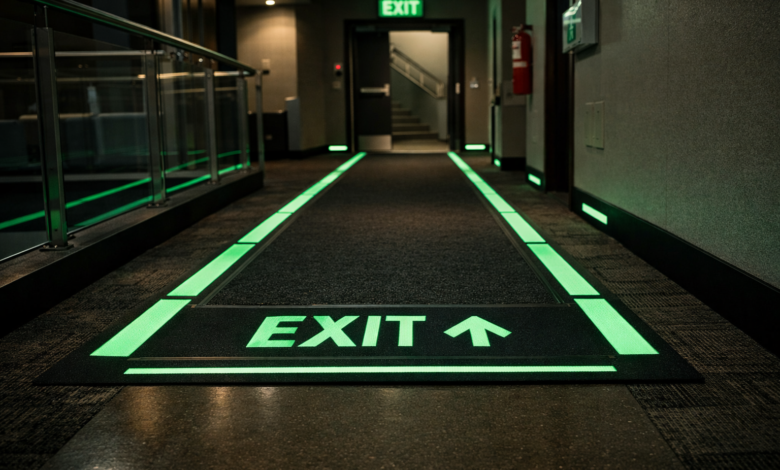
Emergencies never announce themselves politely. They arrive with confusion, noise, fear, and sudden loss of control. Lights go out. Smoke fills corridors. Familiar spaces turn disorienting within seconds. In those moments, survival often depends on one simple question: Where do I go now? Traditional emergency signage has long attempted to answer that question, but modern realities demand a more reliable solution. This is where ExitSignMat technology emerges—not as a minor upgrade, but as a fundamental rethinking of how people find safety under pressure.
ExitSignMat represents a shift from static, overhead signs toward human-centered, floor-level guidance systems designed for real-world emergencies. Instead of assuming calm behavior and clear visibility, this technology accepts the truth of crisis situations: people panic, visibility drops, and power may fail. By guiding occupants along illuminated paths at ground level, ExitSignMat aligns safety design with instinct, physiology, and behavior.This article explores ExitSignMat in depth—its purpose, science, applications, and long-term value—revealing why it is increasingly seen as the future standard for emergency wayfinding systems.
What ExitSignMat Really Is and Why It Exists
ExitSignMat is a specialized emergency wayfinding solution designed to provide continuous visual guidance along evacuation routes, primarily at floor level. Unlike traditional exit signs that offer isolated directional cues, ExitSignMat creates a clear, uninterrupted pathway that naturally leads people toward safety.
Its existence stems from a critical flaw in conventional emergency planning: the assumption that people will notice, understand, and follow overhead signage during a crisis. In reality, emergencies disrupt perception, attention, and decision-making. ExitSignMat was developed to eliminate guesswork and reduce reliance on conscious interpretation.
The mat format allows guidance to exist directly in walking paths—along corridors, stairwells, and exit routes. Whether using photoluminescent materials or low-energy illumination, ExitSignMat remains visible even during power failures. This ensures guidance does not depend on building systems that may be compromised during fires, earthquakes, or other emergencies.At its heart, ExitSignMat exists to simplify evacuation. It transforms complex buildings into intuitive pathways when clarity matters most.
How Human Instinct Shapes ExitSignMat Design
One of the defining strengths of ExitSignMat technology is its grounding in human behavior rather than theoretical safety models. During emergencies, people rarely behave as they do in drills. Panic alters perception. Vision narrows. Hearing becomes overwhelmed. Logical thinking gives way to instinct.
When visibility drops, people instinctively look down to avoid obstacles. Smoke accumulates near ceilings first, making overhead signs difficult or impossible to see. ExitSignMat places guidance exactly where attention naturally falls—on the floor, within the line of sight most people use when moving under stress.
Continuous visual cues are another critical factor. Humans under pressure struggle with fragmented information. ExitSignMat provides an unbroken trail, removing the need to stop, scan, or decide. This continuity reduces hesitation and keeps movement flowing smoothly toward exits.By designing around instinct instead of expectation, ExitSignMat increases compliance, reduces panic, and improves evacuation speed without requiring training or prior knowledge.
The Science Behind Floor-Level Visibility and Light Behavior
The effectiveness of ExitSignMat is supported by basic principles of physics and environmental science. Smoke, heat, and toxic gases rise. Light, when positioned at floor level, travels through clearer air for longer periods during fires and similar emergencies.
Photoluminescent ExitSignMat systems absorb ambient light during normal conditions and release it slowly in darkness. This process requires no electricity, wiring, or batteries. Once charged, these materials can glow for hours, providing reliable guidance even in total power loss.
Low-level illumination also reduces glare and visual confusion. Bright overhead lights can create reflections and shadows that disorient occupants. Floor-level guidance, by contrast, creates a stable visual anchor that is easy to follow.This scientific advantage makes ExitSignMat particularly effective in smoke-filled environments, underground facilities, and enclosed spaces where visibility rapidly deteriorates.
Why Traditional Emergency Signage Falls Short
Traditional exit signs were designed for a different era—simpler buildings, fewer occupants, and lower safety expectations. While still required by regulations, they are increasingly recognized as insufficient on their own.
Overhead signs depend heavily on power, line of sight, and calm interpretation. In emergencies, these conditions often fail simultaneously. Smoke obscures signage, alarms distract attention, and people focus on immediate threats rather than reading instructions.
Another limitation is discontinuity. Traditional signs provide direction only at specific points. If someone misses one sign, they may lose orientation entirely. ExitSignMat addresses this weakness by providing constant guidance rather than isolated information.
This does not mean traditional signs are obsolete. Instead, ExitSignMat complements them, creating redundancy. When one system fails, the other remains effective. Modern safety design favors layered solutions, and ExitSignMat fits seamlessly into this philosophy.
Applications Across Different Types of Buildings
ExitSignMat technology adapts easily to a wide range of environments, making it one of the most versatile safety solutions available today.In commercial buildings, ExitSignMat enhances evacuation efficiency without disrupting interior design. During everyday use, it remains subtle and unobtrusive. During emergencies, it becomes instantly visible, guiding occupants who may be unfamiliar with the layout.
Industrial facilities benefit from the durability and clarity of ExitSignMat systems. In environments with heavy machinery, noise, or hazardous materials, visual guidance must be immediate and unmistakable. Floor-level pathways reduce confusion and help workers navigate safely even in chaotic conditions.
Healthcare facilities present unique challenges. Patients may have limited mobility, sensory impairments, or heightened anxiety. ExitSignMat supports staff by clearly defining evacuation routes, reducing cognitive load during high-pressure situations.
Public spaces such as transit hubs, stadiums, and cultural venues often host large crowds unfamiliar with exit locations. ExitSignMat provides intuitive guidance that transcends language barriers, helping diverse populations move safely and efficiently.
Accessibility and Inclusive Safety Design
True safety design considers everyone, not just the able-bodied or fully alert. ExitSignMat contributes significantly to inclusive emergency planning by supporting a wide range of physical and cognitive needs.
Floor-level guidance is especially beneficial for individuals with hearing impairments who may not respond to audible alarms. It also supports people with cognitive challenges by reducing the need for interpretation and decision-making.
For individuals with limited vision, the high-contrast glow of ExitSignMat can be easier to detect than traditional signage, particularly in low-light conditions. When combined with tactile or textured surfaces, it can also assist those navigating by touch.Inclusive design is no longer optional. ExitSignMat helps organizations move beyond minimum compliance toward genuinely accessible safety environments.
Design Integration Without Compromising Aesthetics
A common concern with safety systems is their visual impact. ExitSignMat addresses this challenge by integrating directly into flooring, allowing safety features to coexist with architectural intent.
Modern ExitSignMat products are available in various finishes and profiles, enabling designers to incorporate them seamlessly into corridors, staircases, and open spaces. In normal lighting, many systems remain nearly invisible, preserving the look and feel of the environment.
This discreet presence encourages wider adoption. Architects, developers, and property owners are more likely to embrace solutions that enhance safety without detracting from visual appeal.Safety no longer needs to look industrial or intrusive. ExitSignMat demonstrates that protection can be elegant, subtle, and effective at the same time.
Durability, Maintenance, and Long-Term Reliability
Emergency systems must work when everything else fails. ExitSignMat excels in this regard due to its simplicity and durability.Photoluminescent systems require minimal maintenance. With no electrical components, there are fewer points of failure. Regular ambient lighting is typically sufficient to keep the material charged and ready.
The materials used in ExitSignMat are designed to withstand heavy foot traffic, cleaning routines, and environmental wear. This makes them suitable for high-use areas without frequent replacement.From a long-term perspective, ExitSignMat offers strong value. Lower maintenance requirements, extended lifespan, and reduced energy consumption translate into cost savings over time.
Reliability is not just about function—it is about confidence. Knowing that guidance will remain visible regardless of circumstances provides peace of mind for building owners and occupants alike.
ExitSignMat and the Evolution of Safety Standards
Safety standards evolve in response to real-world incidents and growing understanding of human behavior. ExitSignMat reflects this evolution by addressing weaknesses identified in past emergencies.Modern regulations increasingly emphasize performance-based outcomes rather than minimal compliance. The goal is not simply to install signs, but to ensure people can evacuate quickly and safely under realistic conditions.
ExitSignMat aligns with this philosophy by improving evacuation speed, reducing confusion, and enhancing visibility. Its growing adoption reflects a broader shift toward proactive, human-centered safety solutions.As expectations rise, systems that merely meet old standards may no longer be sufficient. ExitSignMat positions organizations ahead of this curve, demonstrating commitment to safety beyond basic requirements.
Conclusion: Why ExitSignMat Is the Future of Emergency Wayfinding
ExitSignMat technology exists because reality demanded it. Emergencies are chaotic, unpredictable, and unforgiving. Systems designed for calm conditions inevitably fail when stress, smoke, and darkness take over. ExitSignMat succeeds because it accepts these realities and designs around them.By placing guidance at floor level, aligning with instinctive behavior, and remaining visible without power, ExitSignMat transforms evacuation from a confusing challenge into a clear path forward. Its adaptability, durability, and inclusivity make it suitable for virtually any environment.
The future of emergency wayfinding will not be defined by brighter signs or louder alarms alone. It will be defined by systems that understand people—how they move, how they see, and how they react under pressure. ExitSignMat embodies this understanding.In a world where seconds can save lives, clarity is not a luxury. It is a necessity. ExitSignMat is more than a safety product—it is a statement that human-centered design belongs at the heart of emergency preparedness.
Read also: Mark Hines: Science, Endurance, and the Human Edge