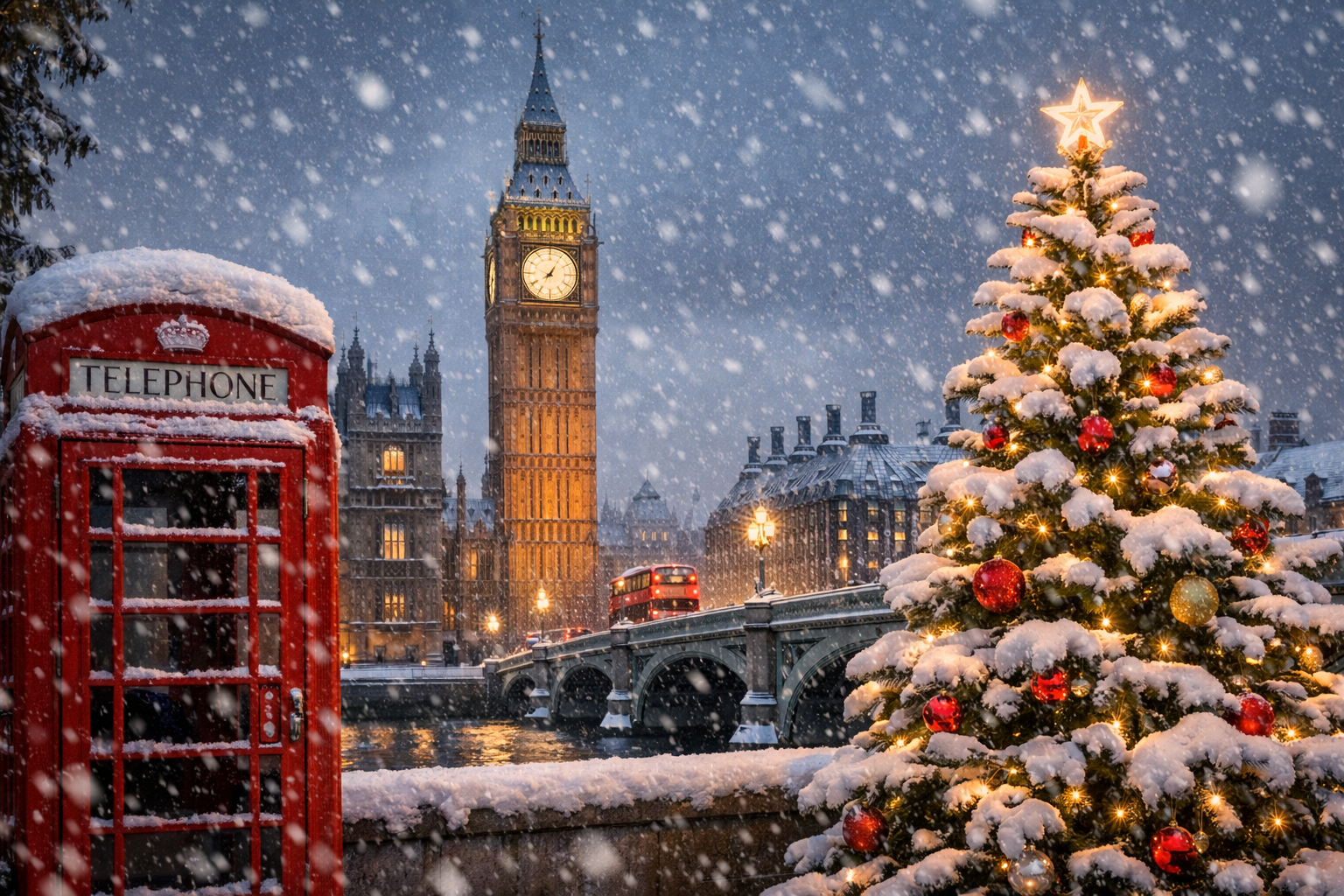
As December deepens and festive lights glow across towns and cities, the United Kingdom finds itself once again watching the skies. Meteorological signals are pointing toward a significant snowstorm risk, raising the tantalising possibility of a White Christmas for parts of the country. While snow at Christmas is far from guaranteed in Britain’s temperate climate, the combination of Arctic air, shifting pressure systems, and an unsettled jet stream has put forecasters and the public on high alert.
For many, the idea of snow falling on Christmas Day carries emotional weight. It evokes nostalgia, childhood memories, and postcard-perfect scenes. Yet beyond the romance lies a serious conversation about disruption, preparedness, and how rare such weather truly is in the UK. This winter, the balance between festive magic and practical reality is sharper than ever.
Why the UK Is Facing Increased Snowstorm Risk
The UK’s winter weather is shaped by a constant tug-of-war between mild Atlantic air and colder Arctic influences. In the lead-up to Christmas, forecast patterns suggest that colder air from the north and northeast may push southward across the British Isles, undercutting milder systems arriving from the Atlantic.
When cold air becomes established near the surface and moist air moves in above it, snowfall becomes possible. This setup is particularly effective during December, when daylight hours are short and ground temperatures can remain low enough for snow to settle, even in lowland areas.
Forecasters have noted growing signs of high-pressure systems developing over Greenland and Scandinavia, a configuration that can divert the jet stream southward. When this happens, the UK is more exposed to Arctic air masses, increasing the likelihood of snow rather than rain. This does not guarantee a nationwide snow event, but it significantly raises the odds of wintry outbreaks.
The Role of the Met Office and Forecast Confidence
Met Office plays a central role in monitoring these evolving conditions. Long-range forecasts often focus on trends rather than specifics, and while confidence grows as Christmas approaches, uncertainty remains part of the picture.
Meteorologists stress that snow forecasting in the UK is especially complex. Small changes in temperature, wind direction, or pressure can mean the difference between heavy snow, sleet, freezing rain, or cold rain. Even a shift of one or two degrees can dramatically alter outcomes.
Current outlooks suggest below-average temperatures around the Christmas period, with an increased chance of snow in northern regions, eastern areas exposed to North Sea winds, and higher ground. Southern England may also see snow if colder air becomes firmly entrenched, though rain remains more likely there under marginal conditions.
What Counts as a White Christmas in the UK
The phrase “White Christmas” is often misunderstood. In the UK, the official definition is surprisingly modest. A White Christmas is recorded if at least one snowflake is observed falling anywhere in the country on 25 December. Snow does not need to settle, and it does not need to fall nationwide.
This definition explains why the UK technically experiences a White Christmas more often than people realise. However, the classic vision of widespread snow lying on the ground across towns and countryside is far rarer. Many years see snow showers in northern Scotland while the rest of the UK remains dry or rainy.
Public perception tends to focus on settled snow, especially in populated areas. When people talk about “finally getting a White Christmas,” they usually mean waking up to snow-covered streets and rooftops, not a brief flurry on a remote hilltop.
Regions Most Likely to See Snowfall
If a significant snowstorm develops, not all regions will be affected equally. Geography plays a major role in determining where snow falls and how long it lasts.
Scotland is statistically the most likely part of the UK to see snow at Christmas. Higher elevations, colder average temperatures, and exposure to Arctic air all increase snowfall potential. Northern England, particularly the Pennines and surrounding areas, often follows closely behind.
Eastern England can also be vulnerable when cold easterly winds bring moisture from the North Sea. These setups can produce persistent snow showers that affect coastal and inland areas alike. Wales may see snow over higher ground, while low-lying areas are more variable.
Southern England faces the greatest uncertainty. Snow is possible during strong cold spells, but temperatures often hover close to freezing, making outcomes highly sensitive to minor atmospheric changes.
How Climate Patterns Influence Christmas Snow
Large-scale climate drivers can shape the likelihood of winter snow in the UK. One of the most influential is the North Atlantic Oscillation, which affects the strength and direction of westerly winds across the Atlantic.
When the North Atlantic Oscillation is in a negative phase, high pressure tends to build to the north of the UK, allowing cold air to flow south. These conditions are more favourable for snow. Conversely, a positive phase usually brings milder, wetter weather from the Atlantic, reducing snow chances.
Sudden stratospheric warming events can also play a role. These dramatic temperature increases high in the atmosphere can weaken the polar vortex, sometimes leading to prolonged cold spells in Europe weeks later. While not every such event results in snow, they often heighten winter weather risks.
Historical Perspective on White Christmases
Looking back through weather records reveals how uncommon widespread Christmas snow really is. Despite popular belief, the UK rarely experiences a fully white landscape on Christmas Day.
Notable snowy Christmas periods include the early 1980s, the mid-1990s, and the winters of 2009 and 2010. Those years were marked by prolonged cold spells that extended well beyond Christmas itself. Many people remember these winters vividly because the snow lingered, disrupting daily life for weeks.
In contrast, most Christmases are relatively mild, with temperatures above freezing for much of the day. Rain is far more common than snow, especially in western and southern regions. This historical context helps explain why even the possibility of snow generates such excitement.
Travel and Infrastructure Impacts of a Snowstorm
A significant snowstorm around Christmas would have implications far beyond festive aesthetics. The holiday period is one of the busiest times of year for travel, placing additional strain on transport networks.
Snow and ice can lead to road closures, rail delays, and airport disruptions, particularly if conditions develop rapidly. Rural areas are often more vulnerable, with untreated roads and limited access to emergency services. Even urban centres can struggle if snowfall coincides with freezing temperatures overnight.
Energy infrastructure may also be affected. Heavy snow and ice can damage power lines, while increased demand for heating places pressure on energy supplies. Local authorities typically prepare grit stocks and contingency plans well in advance, but extreme or prolonged conditions can still cause difficulties.
Health and Safety Considerations During Cold Weather
Cold weather carries health risks, especially for vulnerable populations. Prolonged exposure to low temperatures increases the risk of hypothermia, respiratory illnesses, and cardiovascular strain.
Older adults, young children, and those with pre-existing health conditions are particularly at risk. Icy conditions also raise the likelihood of slips and falls, which can result in serious injuries. Health services often see increased demand during cold spells, adding to seasonal pressures.
Public health advice usually focuses on staying warm indoors, checking on neighbours, and avoiding unnecessary travel during severe weather. Simple measures can make a significant difference when temperatures drop sharply.
Public Fascination With Snow at Christmas
Despite the risks and disruptions, the idea of snow at Christmas continues to captivate the public imagination. Literature, film, and tradition have cemented snow as part of the festive ideal, even though it does not reflect the UK’s typical climate.
This fascination speaks to something deeper than weather alone. Snow transforms familiar landscapes, creating a sense of stillness and novelty. At Christmas, a time already charged with emotion and meaning, that transformation feels especially powerful.
Social media has amplified this effect. Even the hint of snow in forecasts can spark widespread discussion, speculation, and excitement, with people sharing memories and hopes long before any flakes fall.
Balancing Hope and Realism in the Forecast
Forecasters are careful to strike a balance between acknowledging snow potential and avoiding unnecessary alarm or false expectations. Long-range models are best viewed as guidance rather than guarantees.
As Christmas approaches, forecast confidence will improve, allowing clearer regional detail. Until then, the message remains one of cautious optimism for snow lovers and practical preparedness for everyone else.
The UK’s weather is famously changeable, and Christmas forecasts are among the most closely watched of the year. Even with strong signals for colder conditions, surprises are always possible.
Conclusion
The UK stands on the edge of a familiar yet compelling winter question. A significant snowstorm is possible, and with it comes the chance of a White Christmas that many will greet with excitement and wonder. Atmospheric patterns suggest colder-than-average conditions, and for some regions, snow may indeed fall as festivities unfold.
Yet history reminds us that Christmas snow is rare, unevenly distributed, and often fleeting. While the romance of snow captures the imagination, the reality demands awareness, preparation, and respect for the power of winter weather.
Whether Christmas morning dawns white or green, the anticipation itself is part of the season’s magic. In watching the forecasts, sharing hopes, and preparing for what may come, the nation once again unites around the simple, timeless question of what the weather will bring.
Read also: Tim Montgomerie Health Problems: Facts, Rumours, and the Truth Behind Public Speculation